


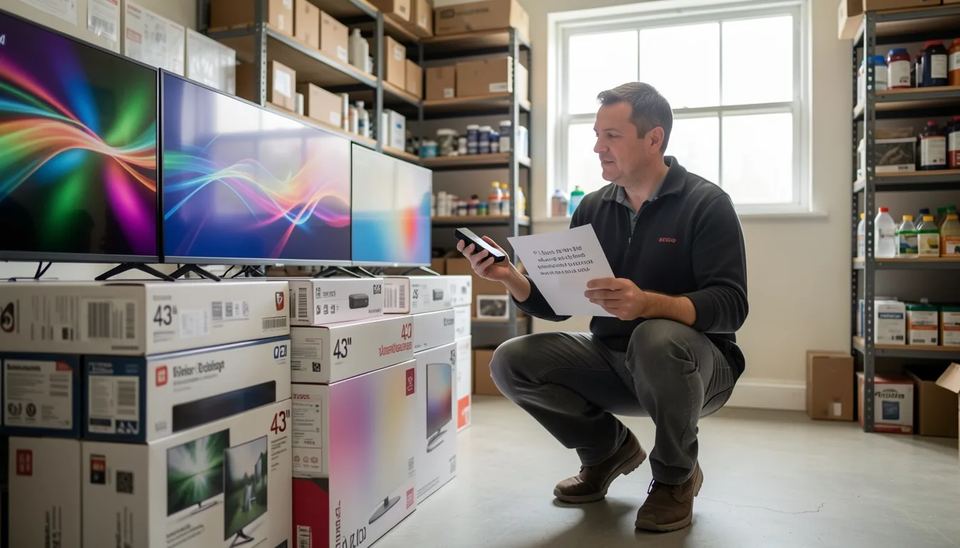
Omdia data reported between 30 September and 6 October 2026 shows the processor board now makes up 45% to 50% of the hardware cost of 32 and 40 inch LCD TVs, up from just over 10% in Q2 2025. DRAM costs 4.4 times more than a year ago and NAND about 9 times more. Expect budget screens and media players to get pricier.
Key takeaways
- In 32 and 40 inch LCD TVs, the chips inside now cost about as much as the panel, or more, according to Omdia.
- DRAM hit about $25 per chip in August 2026, 4.4 times last year, and NAND flash reached $30.50, almost 9 times.
- Micron warns that tight memory supply and high prices could last into 2028 and beyond.
- Cheap TVs used as menu boards, SoC displays and media players are the most exposed signage hardware.
- If you have approved screen orders for the next two quarters, place them now and keep the screens you already own running with a separate player.
What did Omdia find about TV chip costs?
The most expensive part of a small TV is no longer the screen. DigiTimes broke the Omdia figures on 30 September, TechRadar followed on 3 October, and invidis put it in signage terms on 6 October.
| Component | A year ago | Now (2026) |
|---|---|---|
| Processor board, share of small TV cost | just over 10% (Q2 2025) | 45% to 50% (Q3 2026) |
| Basic DRAM chip | about a quarter of today's price | about $25 (August), 4.4x |
| NAND flash chip | about a ninth of today's price | $30.50, about 9x |
| Wi-Fi module | minor cost line | in some cases more than the panel |
The panel itself still costs money, of course. The shift is that memory, storage and wireless parts, small line items for 15 years, now set the price of entry-level screens.
Why is this happening and how long will it last?
AI data centers are buying most of the world’s memory. Hyperscalers are spending hundreds of billions on AI servers, and memory makers give those buyers priority over TV and set-top box makers.
Relief is not close. Micron, per invidis, says shortages and high DRAM and NAND prices could run into 2028 and beyond. Omdia also expects TV makers to send scarce parts to premium models: it forecasts global TV shipments down 1% in 2027 while high-end shipments grow 9.3%.
Which signage hardware gets hit first?
The cheapest hardware takes the biggest hit, because memory is a bigger slice of its cost. In order of exposure:
- Consumer 32 to 43 inch TVs used as menu boards and window screens. Margins are thin, so price rises or quiet spec cuts come first.
- SoC displays (System on Chip: the media player is built into the screen, so the panel carries its own processor, RAM and storage). See our SoC display explainer.
- Media players and HDMI sticks, which are mostly memory, storage and a Wi-Fi chip in a small box.
- Interactive kiosks with touch controllers and extra RAM.
Large premium displays feel it less, since chips are a smaller share of a 75 inch commercial panel’s bill of materials.
What should you do with your screen budget now?
Act on hardware you have already approved, and stretch the life of what is on the wall.
- Bring forward Q4 and Q1 orders. Ask your reseller how long the quote is valid and whether stock is allocated to you.
- Keep working screens. A two year old smart TV can run a player app or take an external player, instead of being replaced.
- Separate the screen from the computer. When a built-in SoC gets slow, you swap a $140 player, not a $600 display.
- Do not save money on storage. A player with too little flash cannot cache 4K loops for offline playback, and you pay later in truck rolls.
A cafe with two menu boards on 43 inch TVs should keep the TVs and add players rather than buy new screens in 2027. A retailer planning 40 new stores next year should lock in the hardware price now and redo the budget with our 2026 cost breakdown and the hidden costs checklist.
Where do Look DS players fit in this?
Look DS gives you two ways to avoid buying new screens: the free Look Player app on Android, Windows, Linux, macOS, LG webOS, Samsung Tizen, Raspberry Pi and Fire OS, or a dedicated player. The new Look Verde PRO costs $149 with 4 GB DDR4 and 32 GB storage, runs off the TV’s USB port and has been on pre-order since 25 September 2026.
One limit: Look players ship from Look’s own shop, not from big retailers. For other options, see our 2026 player guide.
Disclosure: Digital Signage Trends is published by Look Digital Signage.
FAQ
Will digital signage displays get more expensive in 2027?
Entry-level screens are the most likely to rise, because chips now make up about half of a 32 or 40 inch TV’s cost. Omdia expects makers to send scarce parts to high-end models. Premium commercial displays are less exposed, but quotes will not drop.
Should I buy screens now or wait?
If the project is approved and the sites are ready, buy now. Micron does not expect memory prices to ease before 2028. Waiting only makes sense if your rollout has no firm date.
Are media players affected as much as TVs?
Yes, and possibly more, since a player is mostly RAM, flash storage and a Wi-Fi chip. Check the spec sheet on new orders so a lower price does not mean less storage or older Wi-Fi.
Does this affect CMS subscription prices?
The Omdia data covers hardware, not software. Cloud CMS pricing depends on servers too, but no major signage CMS has tied a price change to this report. Ask your vendor before you renew.
How can I make existing screens last longer?
Run a player app on the TV or attach an external player, schedule nightly reboots and keep firmware auto-updates under control. Our troubleshooting guide covers the usual failures.
Sources
- invidis: AI Memory Crunch Reshapes Display Economics (Oct 2026)
- TechRadar: TVs are finally being hit hard by the AI-fueled memory crisis (3 Oct 2026)
- DigiTimes: Memory shortage pushes TV semiconductors above panel costs (30 Sep 2026)
- Wilson’s Media: The component cost crisis is hitting TVs hard now
- Aroged: Fewer but more expensive TVs, the memory crisis affects TV too