


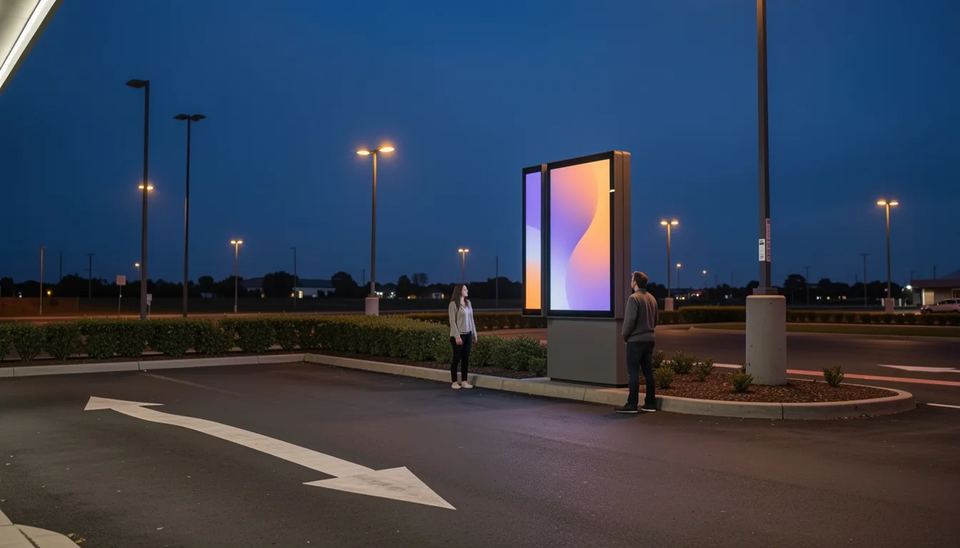
In early November 2026, attackers guessed a weak default password on the signage CMS of a German franchisee of a well-known QSR chain and raised the prices on its digital menu boards. Staff did not catch it. Customers did. It happened the same week hackers pushed supermarket freezers in 7 European countries to 50°C.
Key takeaways
- A German QSR franchisee’s menu boards showed higher prices after attackers guessed a weak default password on its signage CMS, invidis reported in November 2026.
- Nobody on staff noticed the change; customers spotted the higher prices first.
- The attack needed no malware, only a login that nobody had changed since installation.
- Screen owners should change every default password, remove shared logins and run a daily price check against the POS this week.
- When you choose a signage vendor, ask about forced password changes, two-factor login, user roles and a publish log.
What happened at the German QSR franchisee
According to invidis, attackers got into the franchisee’s CMS by guessing a weak default password. A CMS (content management system) is the web dashboard that decides what every screen shows. The change went unnoticed until customers saw the higher prices.
Neither the chain nor the franchisee has been named. AV Magazine picked up the story on November 9. It quoted invidis managing director Florian Rotberg, who said security still gets low priority even though signage is now business-critical infrastructure.
Why it landed in the same week as the freezer attacks
The menu board hack came days after a much larger attack on store equipment. Overnight on November 1 to 2, attackers forced refrigeration controllers into defrost mode in Belgium, Luxembourg, Sweden, Ireland, Estonia, Finland and the Netherlands, TechRepublic reported. One Swedish store found its fridges and freezers set to 50°C.
The damage added up fast. About 40 Delhaize stores were hit, and 13 of 223 SuperValu stores in Ireland, according to BankInfoSecurity. Freezer controllers and screens have the same weak spot: they sit online in a store, often with factory logins nobody has touched since the installer left.
What a hacked menu board costs a restaurant
invidis expects the QSR fallout was mostly customer complaints, damage to the brand and some lost revenue. On a busy lunch shift that still means real money. The cashier has to argue with every guest who saw a different price, and the shift manager has to call someone who knows the CMS login.
Two situations we see a lot:
- A franchisee with 3 restaurants and 9 menu boards. One admin login, set up by the installer in 2021, shared by three managers. A changed price stays up for days because everyone assumes someone else edited it.
- A gym with 6 screens. A former marketing assistant still has an active account. Nothing has to be hacked at all.
A 50 cent price rise is the quiet version. The same access lets someone put any image on a screen facing your counter.
What to check on your screens this week
You can do most of this in under an hour per site.
- Change every default password: the CMS admin, the media player’s settings and the display’s own admin menu.
- Give every person their own login. Delete shared accounts and anyone who has left.
- Use roles so shift staff can edit their store’s playlist but cannot publish to every screen.
- Turn on two-factor login if your CMS has it.
- Put players on their own network segment (a separate VLAN or guest Wi-Fi), not on the POS network.
- Update player firmware. Our XCPE botnet report shows what happens to cheap Android boxes that never get updates.
- Add a 2 minute opening check: the manager compares three prices on the board with the POS.
For menu setup basics, see our digital menu boards guide.
What to ask your signage software vendor
Security rarely makes it into the demo, so put it on your checklist. Our guide to choosing a signage software provider covers the rest.
| Question | Why it matters |
|---|---|
| Does it force a password change on first login? | Stops installer defaults staying live |
| Is two-factor login available? | A guessed password is no longer enough |
| Can I set user roles per location? | Limits what one stolen login can change |
| Is there a log of who published what? | You find the change in minutes, not days |
| Can prices come from the POS? | A manual edit on the board stands out against the source data |
| How fast do player security updates ship? | Old firmware is the second open door |
FAQ
Which QSR chain was hacked?
The chain has not been named. invidis described the victim as a German franchisee of a well-known QSR chain. The attack hit the franchisee’s own signage system, not the chain’s network.
How did the attackers get in?
They reportedly guessed a weak default password on the signage CMS. No malware or software flaw was involved. That makes it one of the easiest attacks to prevent.
How would I notice if my menu boards were changed?
Turn on publish notifications or check the activity log if your CMS has one. Add a daily check where the opening manager compares a few board prices with the POS. Our troubleshooting guide covers other checks worth adding.
Is a cloud CMS riskier than an on-premise one?
Both depend on who holds the logins. A cloud CMS can be reached from anywhere, so strong passwords and two-factor login matter more. An on-premise server only helps if it is patched and kept off the open internet.
Is this linked to the supermarket freezer attacks?
No link has been reported. Both attacks hit store equipment that was reachable online with weak protection, in the same week. That is reason enough to audit screens and other connected devices together.
Sources