


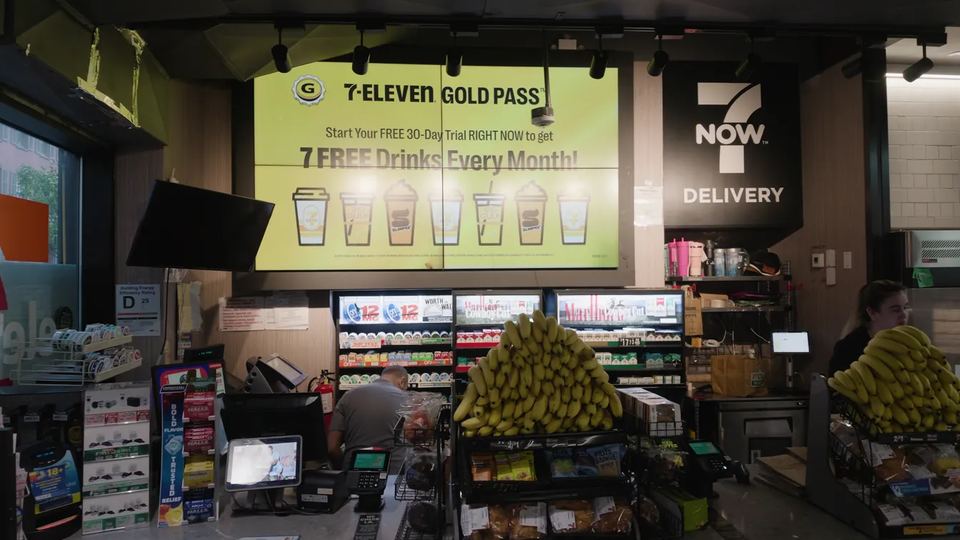
Japan’s two biggest convenience chains are turning the screen above the till into a paid ad slot. FamilyMart runs screens in about 12000 stores. 7-Eleven is at roughly 3700 stores and plans to reach 8700, Digital Signage Today reported on November 23, 2026. If your store has a screen over the counter, suppliers may now pay to be on it.
Key takeaways
- FamilyMart has digital signage in about 12000 Japanese stores and 7-Eleven in about 3700, with 7-Eleven targeting 8700 stores this fiscal year.
- 7-Eleven runs its screen ads through Seven-Eleven Ad Connect, a joint venture it owns 80% of, with Dentsu and CyberAgent at 10% each.
- Ads are matched to weather, time of day and live stock levels, not just played on a fixed loop.
- Any retailer with checkout screens can copy the model on a small scale: sell 15-second slots to suppliers and back them with proof-of-play logs.
What did FamilyMart and 7-Eleven announce?
Both chains are scaling in-store screens to sell ads and lift purchases. Digital Signage Today’s November 23 report, based on The Straits Times, put FamilyMart at 12000 stores with screens and 7-Eleven at about 3700. (The report prints the 7-Eleven target as “8,7000”. The figure is 8700, as The Japan Times reported in June.)
Japanese convenience stores with in-store digital signage, November 2026 (stores)
Source: Digital Signage Today: Japan c-store chains expand digital signage footprints
The 7-Eleven push runs through Seven-Eleven Ad Connect, a joint venture that started on September 1 with ¥100 million in capital. Dentsu analyses purchase data and CyberAgent creates the ads with AI. Placement is tuned to weather, time of day and real-time inventory in each store. Seven-Eleven aims for ¥20 billion in advertising and related revenue by fiscal 2030.
| Chain | Stores with screens | Ad network | Status |
|---|---|---|---|
| FamilyMart | about 12000 | Famima TV | Running since 2021 |
| 7-Eleven Japan | about 3700, target 8700 | Seven-Eleven Ad Connect | Scaling |
| Lawson | Not disclosed | None public | Pilot |
FamilyMart’s Famima TV reaches more than 15 million people per day, according to AV Magazine. Its standard store setup is a 3x1 row of LCD screens above the checkout, as invidis describes. Lawson is still testing screens.
Why it matters if you run screens in a store
The checkout screen is the one every customer looks at, because the queue gives them 30 to 90 seconds with nothing else to do. Japan’s chains now treat that position as media with a price, not as decoration. The money comes from suppliers: drink, snack and tobacco brands already pay for shelf space and end caps.
The data is what makes these ads worth buying. 7-Eleven kept 80% of the joint venture so it controls the purchase data, and advertisers pay for that link between ad and till. This is the same direction we covered in our programmatic DOOH report, where retail led and private deals dominated.
Most small stores have the opposite problem. The screen above the till plays the same loop it played last spring, the TV updated itself and now shows its home screen, and nobody on staff knows who owns it.
What a small chain can copy
Two setups show how this scales down.
A single convenience store with 3 screens above the counter can offer its beverage distributor 2 slots of 15 seconds in a 60-second loop. That leaves half the airtime for the store’s own coffee and sandwich deals. Even one supplier paying a monthly fee can cover the software and player costs.
A regional chain of 8 fuel forecourt shops has more to sell: the same slot across every store, scheduled for the morning commute. For a supplier that is one booking instead of 8 phone calls, which is what makes it buyable.
What to do now
- Map your screens by position. Above the checkout comes first, then the entrance, then the cooler doors.
- Cut your loop into fixed 15-second slots, the length FamilyMart uses, and keep at least half for your own promotions.
- Schedule by daypart: hot coffee before 10 am, cold drinks on warm afternoons. Our guide to scheduling content by time of day covers the setup.
- Turn on playback logs. A supplier will ask how many times their ad played, and proof of play is your invoice backup. See how to measure signage ROI.
- Pull ads for products that are out of stock. 7-Eleven automates this with inventory data. With 3 screens, a staff member checking the cooler each morning does the job.
- Lock down access before selling airtime. A paid slot showing the wrong content is a refund. The QSR menu board hack started with a default password.

FAQ
How many stores in Japan have digital signage at checkout?
FamilyMart has screens in about 12000 stores and 7-Eleven in about 3700, according to Digital Signage Today’s November 2026 report. 7-Eleven plans to reach 8700 stores within its current fiscal year. Lawson is still running a pilot.
What is retail media on in-store screens?
Retail media means a retailer sells ad space on its own channels, here the screens inside its stores. Suppliers pay to show their products near the point of purchase. The retailer’s sales data shows whether the ads worked.
How long are convenience store screen ads?
FamilyMart typically runs 15-second spots on the screens above its registers. That length fits a queue and lets one loop rotate several advertisers. Most signage software can schedule slots of that length.
Can a single store sell ads on its screens?
Yes, on a small scale. The usual buyer is a supplier you already work with, such as a drinks distributor, paying a monthly fee for fixed slots. You need scheduled slots, playback logs and a simple agreement on what plays and when.
Do I need new screens to start?
Usually not. A commercial display or a decent TV above the counter with a dedicated media player is enough. The bigger change is in scheduling and reporting, not hardware.
Sources
- Digital Signage Today: Japan c-store chains expand digital signage footprints (Nov 23, 2026)
- The Japan Times: Seven-Eleven Japan ties up with ad firms for digital signage business
- News On Japan: Seven-Eleven, Dentsu launch new advertising venture
- AV Magazine: Huge digital signage network shows Japan’s most wanted
- invidis: Family Mart, reinventing the convenience store
- invidis: Japan, Seven-Eleven rolls out retail media