


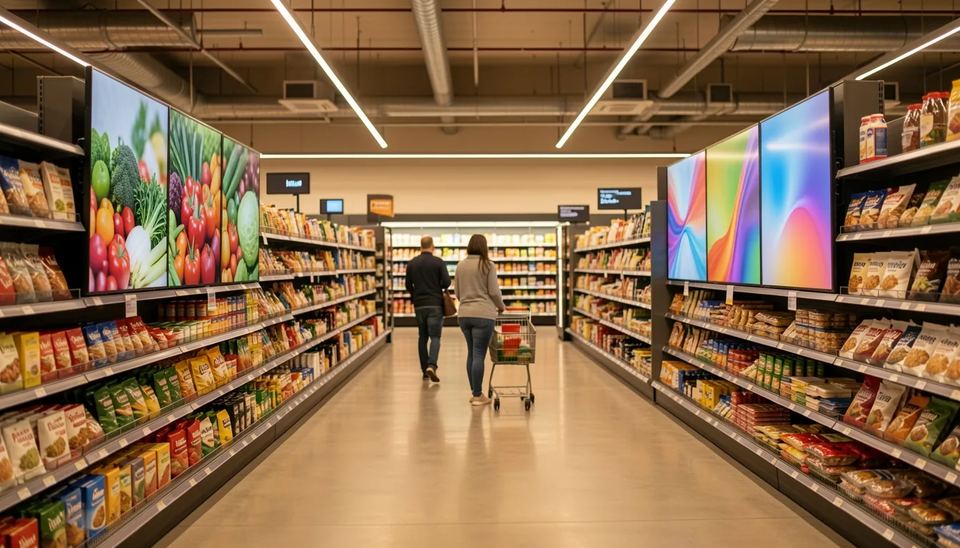
The digital signage trends that matter in 2026 are practical ones. Research firms put the market at $21 billion to $34 billion this year. Screens cost more because memory chip prices have gone up sharply. E-paper and MicroLED were all over the trade show floors, AI now produces content inside the editor, and in-store screens are turning into paid ad space.
Key takeaways
- Estimates for the 2026 digital signage market range from $21.07 billion (MarketsandMarkets) to $33.6 billion (Grand View Research), with growth of 6.6% to 9.6% a year depending on what each firm counts.
- Hardware is the biggest change: contract prices for the 4 GB DDR4 memory used in 4K TVs more than quadrupled in a year, so screens and players bought later will likely cost more.
- For a small business starting out in 2026, a cloud CMS such as Look DS running on TVs you already own or on low-cost players is still the quickest and cheapest way to launch. AI tools built into the editor cut the time it takes to produce content.
- US in-store retail media ad spend is forecast to grow 33.1% in 2026, which turns store screens into a revenue line instead of a cost line.
- Amazon’s newest Fire TV Sticks run Vega OS and block sideloaded apps, so check the operating system before you buy a cheap stick as a signage player.
How big is the digital signage market in 2026?
It is somewhere between $21 billion and $34 billion, depending on who is counting and what they include. Hardware-only estimates come out low. Estimates that include content and services come out high.
Global digital signage market size, USD billion (Grand View Research)
Source: Digital Signage Market Size And Share Report, 2026-2033 (Grand View Research)
| Research firm | 2026 value | Forecast | Growth per year |
|---|---|---|---|
| MarketsandMarkets | $21.07 bn | $30.91 bn by 2032 | 6.6% |
| The Business Research Company | $25.12 bn | $36.31 bn by 2030 | 9.6% |
| Mordor Intelligence | $29.95 bn | $44.60 bn by 2031 | 8.28% |
| Grand View Research | $33.6 bn | $58.4 bn by 2033 | 8.2% |
Grand View Research says North America held a 35.6% revenue share in 2025. The 2024 version of this article put that share at 40%. MarketsandMarkets expects Asia Pacific to grow fastest, at 8.1% a year, with hardware still the biggest slice of spending.
Every firm shows steady growth, and none shows a boom. For a buyer, that means a mature market: there are plenty of vendors, prices for software are fairly stable, and the real swings in your budget come from hardware.
Why do screens and players cost more in 2026?
AI data centers are buying up memory chips, and TVs and media players use the same ones. TrendForce reported that contract prices for 4 GB DDR4 more than quadrupled in a year. Memory went from 2.5% to 3% of a TV’s bill of materials to 6% to 7%, and TrendForce called retail price rises for new models unavoidable.
It got worse through the year. Omdia figures reported by FlatpanelsHD in October 2026 put the mainboard of a 55-inch UHD LCD TV at $118.20, nearly 3.5 times the $33.90 of a year earlier. For 32 to 43-inch TVs, the board now costs more than the panel.
That hits the cheap screens hardest, and those are exactly the 43-inch sets most cafes and shops use for menu boards. What we tell clients:
- Get quotes for the whole rollout now and lock the price, rather than buying store by store.
- Reuse working TVs and add an external player. A $150 player costs less than a new smart screen.
- Skip 8K. Nobody standing 3 meters from a menu board can see the difference from 4K.
- Plan for 10 to 12 months of lead time on large orders.
Our memory crunch report has the full price data.
Which display technologies are worth watching?
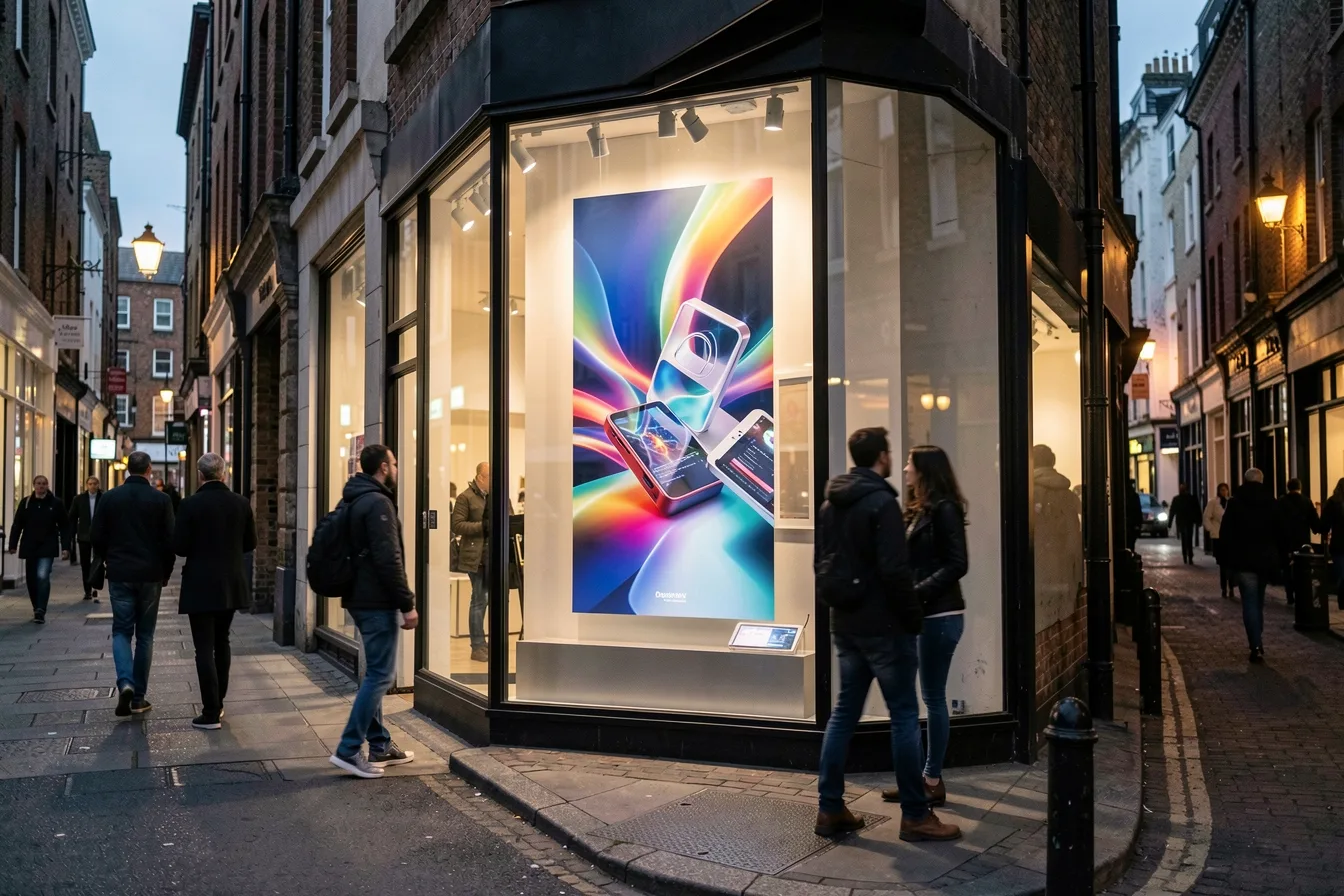
Color e-paper for low-power information signs, MicroLED for large premium walls, and glasses-free 3D for storefronts. A plain 4K LCD is still the right choice for 90% of business screens. These three are what changed at ISE 2026 in Barcelona.
| Technology | Best for | What to know |
|---|---|---|
| Color e-paper | Timetables, room signs, shelf and price signs | Uses power only when the image changes, slow refresh, no video |
| MicroLED | Lobbies, flagship stores, video walls over 100 inches | Premium price, very bright, no burn-in |
| Glasses-free 3D (spatial) | Shop windows, showrooms | Content has to be made for depth |
| 4K LCD | Menus, waiting rooms, offices | Cheapest per inch, but watch glare and brightness in windows |
Samsung’s Color E-Paper needs zero power to keep an image on screen. That changes the cost math for a hospital with 200 door signs that would otherwise need power and data cabling at each one. Samsung also showed Spatial Signage in 85, 55 and 32-inch sizes for 3D depth without glasses, and LG showed a 136-inch chip-on-glass MicroLED wall.
Regulation is also pushing efficient screens. Mordor Intelligence notes that EU rules cap the energy efficiency index of displays and require seven years of spare parts support. The “green” trend from 2024 is now a compliance issue for anyone buying screens in Europe.
How are SoC screens and streaming sticks changing player choice?
More screens now run the signage app on the processor built into the display, and cheap consumer sticks have become a riskier bet. SoC means system on chip: the small computer inside a professional screen, such as Samsung Tizen or LG webOS, that can play content without a separate box. We cover the trade-offs in our SoC displays guide.
The big surprise this year came from Amazon. According to AFTVnews, Vega OS devices do not support sideloading, and Amazon says all future Fire TV Sticks will run it. If your signage app is not in the Amazon Appstore, a new $35 stick will not run it. Our Vega OS breakdown lists which models still work.
Windows 10 support ended on 14 October 2025. Any PC player still running it gets no security patches. That matters on a corporate network, where IT will eventually pull it off the network.
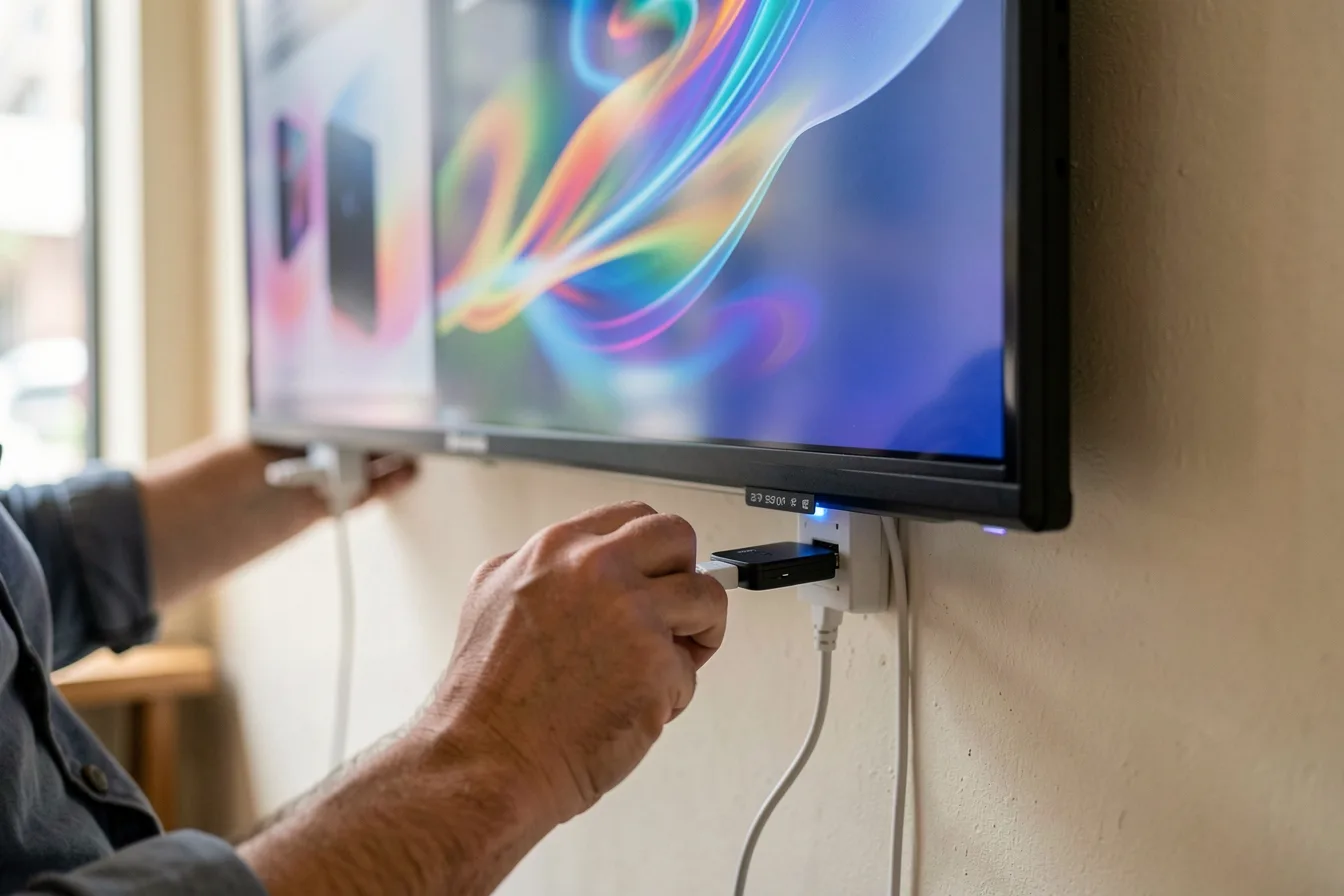
The friction we see most in the field has nothing to do with chips. Consumer TVs update themselves overnight and reboot to their home screen, and the screen shows the TV menu until somebody notices. Dedicated players fix that with auto-start and a watchdog that restarts the player when it hangs. Look’s new Verde PRO, a $149 HDMI stick on the players page, runs from the TV’s USB port. It switches the TV on and off over HDMI CEC and has a hardware watchdog, so you need no power brick and no free socket behind the screen.
How is AI used in digital signage in 2026?
Mostly for making content and buying ads. The face recognition that 2024 trend lists predicted has not caught on. In VIOOH’s 2026 survey, 90% of respondents used AI in at least one stage of a programmatic campaign. The top uses were creative generation (40%), predictive forecasting (38%) and inventory selection (37%).
On the show floor, “interactive” also became more subtle. Reviews of ISE 2026 describe cameras and sensors used for people counting and audience analytics rather than gesture control. For most businesses, the useful AI sits inside the CMS (content management system, the software where you build playlists and schedules):
- Generate a product or food image from a text prompt
- Remove a background or an object from a photo you already have
- Turn a still image into a short video clip
- Shorten, rewrite or translate on-screen text
Look DS is rolling out six such tools in its content editors from the week of 28 September 2026. Every AI action saves a new file, so the original stays in the library, and the price shows before you run it. Picture a cafe owner who used to wait a week for a designer. Now they can generate a seasonal drink image, cut out the background and drop it into the menu template the same afternoon. The AI content tools overview compares what different platforms offer.
Are screens becoming ad inventory?
Yes. Retail media and programmatic DOOH are the trends most likely to change who pays for screens. DOOH (digital out-of-home) means ads on screens in public places. Programmatic means that ad time is bought automatically through software, with an SSP (supply-side platform) selling the screen time and a DSP buying it.
The numbers are moving fast:
- Global DOOH spending rose 12% to $27.47 billion in 2025, according to PQ Media, the fourth double-digit year in a row.
- US programmatic OOH spend will pass $1.2 billion in 2026, about one third of DOOH, and private marketplaces handled 96% of programmatic OOH deals in H1 2025, per EMARKETER.
- US in-store retail media ad spending is forecast to climb 33.1% in 2026, from a base still under 1% of total retail media.
Take a 12-store grocery chain with endcap screens. It can sell screen time to its own suppliers, with no ad exchange involved. To do that, it needs proof-of-play reports showing what ran, where and how often, and someone on staff who owns the schedule. Our report on private deals in programmatic DOOH explains how retailers set this up.
Which 2024 predictions held up?
About half. Cloud management and interactivity became standard. 8K and the facial recognition hype did not.
| 2024 prediction | Status in 2026 |
|---|---|
| Cloud CMS replaces USB sticks | Done. Cloud is the default, and offline playback covers Wi-Fi drops |
| 8K and 16K screens go mainstream | No. 4K is the business standard, and 8K stays in large LED walls |
| OLED replaces LCD | Partly. OLED and MicroLED grew at the premium end, LCD still dominates |
| AI facial and voice recognition | Shifted. AI went into content creation and ad buying |
| 3D billboards | Grew into glasses-free spatial screens for normal stores |
| Sustainability | Now regulated in the EU, plus e-paper for always-on signs |
What do these trends mean for your screen plan?
Most businesses only need to act on two of them: hardware prices and AI content tools. The rest depends on your setup.
Cafe with 2 menu boards. Keep the TVs you have, add a player to each and use a cloud CMS with menu templates. Use AI images for seasonal specials. Turn screen brightness up or move a screen if the afternoon sun washes out the window board.
Gym with 6 screens. Schedule class timetables and member promos by time of day. Give one person on staff clear ownership of the content, or the January offer will still be running in April.
Clinic waiting room. Check offline playback, because clinic Wi-Fi often sits behind strict firewalls. Consider e-paper for door and room signs.
Retail chain of 10+ stores. Lock hardware quotes now because of the memory crunch, and choose a CMS with proof-of-play reports so you can sell screen time later.
Cost ranges for each setup are in our 2026 digital signage cost breakdown.
Disclosure: Digital Signage Trends is published by Look Digital Signage.
FAQ
What are the biggest digital signage trends in 2026?
The five that matter most are higher hardware prices caused by the memory chip shortage, color e-paper and MicroLED displays, AI tools for making content, in-store retail media, and programmatic DOOH buying. Cloud management is no longer a trend. It is the default.
How big is the digital signage market in 2026?
Estimates range from $21.07 billion (MarketsandMarkets) to $33.6 billion (Grand View Research). The gap comes from scope: some firms count only hardware and software, others add content and services. Most forecast growth of 6% to 10% a year.
Will digital signage screens get more expensive in 2026?
Very likely, especially 32 to 43-inch screens. Omdia data shows the mainboard of smaller LCD TVs now costs more than the panel because of memory prices. Locking quotes early and reusing working TVs with an external player are the simplest ways to protect your budget.
Can I still use a Fire TV Stick as a signage player?
Only certain models. Amazon’s newer sticks, such as the Fire TV Stick 4K Select and the 2026 Fire TV Stick HD, run Vega OS and cannot install apps from outside the Amazon Appstore. The Android-based Fire OS models still work, but Amazon says all future sticks will run Vega OS.
Is e-paper good for digital signage?
It works well for signs that change a few times a day: timetables, room signs, prices and directions. Color e-paper uses power only when the image changes, so it can run with little or no cabling. It cannot play video and refreshes slowly, so keep LCD or LED for menus and promotions.
Do small businesses need AI for digital signage?
You do not need it, but it saves time if you make your own content. Generating an image, removing a background or translating text inside the CMS takes minutes and costs less than a designer. Check whether the tool shows the price before you run it and keeps your original files.
Sources
- Digital Signage Market Size And Share Report, 2026-2033 (Grand View Research)
- Digital Signage Market Size, Share & Trends (MarketsandMarkets, Jan 2026)
- Digital Signage Market Report 2026 (The Business Research Company)
- Digital Signage Market Analysis 2026-2031 (Mordor Intelligence)
- Surging Memory, Panel, and Precious Metal Prices Weigh on TV Brand Profitability (TrendForce)
- Many TVs are about to become more expensive, warns Omdia (FlatpanelsHD)
- Samsung Highlights Spatial Signage, Color E-Paper at ISE 2026 (rAVe)
- ISE 2026: LG presented innovations in LED tech, digital signage software and e-paper
- Fire TVs that don’t support sideloading due to Vega OS (AFTVnews)
- VIOOH State of the Nation 2026 Global Report
- Future of Digital Signage: ISE 2026 Review & Insights
- PQ Media Research: Global DooH Spending Grew 12 Percent In 2025 (invidis)
- FAQ on AI in OOH advertising 2026 (EMARKETER)
- In-store experience becomes retail’s pressure valve in 2026 (EMARKETER)